You have probably noticed how much of what you see online is paid for. A banner beside an article, a sponsored result at the top of a search, a short video ad before the clip you actually wanted. Behind each of those placements sits someone who wrote the copy, picked the audience and checked the numbers. Increasingly, an AI tool helped with at least one of those steps. That raises a plain question for anyone who works in paid media: do you know when the tool is right, when it is guessing, and what you are allowed to feed it?
Microsoft's AI Business Professional credential (AB-730) is built around that kind of judgment. Below is a look at one rehearsal option, a study title from Be Ready Education, a small publisher focused on vendor exams. It has no tie to Microsoft, and this article makes no claim about your result.
The problem for people who buy and review ads
Think about the daily routine of a paid media specialist. An assistant produces twenty headline variations in a minute. Someone has to decide which ones are accurate, which ones overclaim, and which ones quietly use customer details that should never have been pasted into a chat window. The skill is less about typing prompts and more about reviewing output, spotting weak spots and knowing the risks.
That is the territory a fundamentals-level AI exam tends to cover: what AI can and cannot do in a business, how to use it responsibly, and how to keep data safe. The Be Ready page for the exam lists it at the Fundamentals level. It does not publish a skills breakdown, so the first step is to read Microsoft's own exam page for the official list of topics.
A credential will not improve your creative eye. What it can do is give you a defined goal and a structured reason to review the basics you may have picked up by trial and error.
What is inside
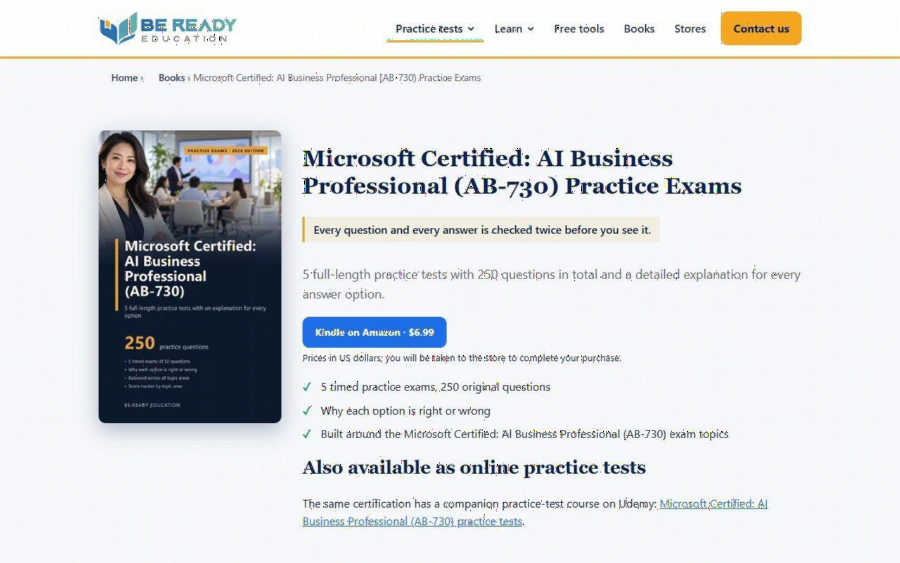
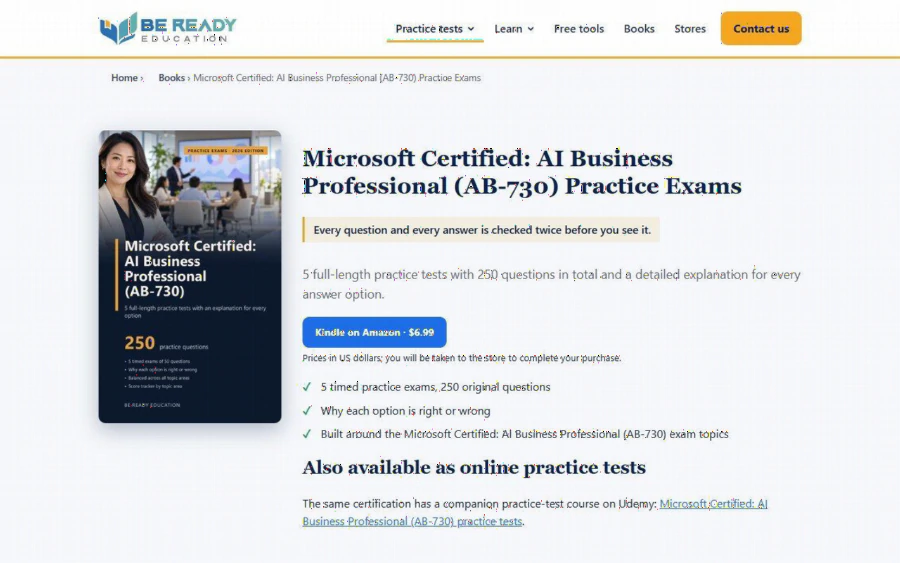
The listing for the AB-730 AI Business Professional book from Be Ready Education promises the following:
- Five timed sets, 250 original questions overall
- A rationale behind every choice, correct or not
- A design that follows the AB-730 topics
- Kindle delivery through Amazon at $6.99 (prices are in US dollars, and checkout happens on the store)
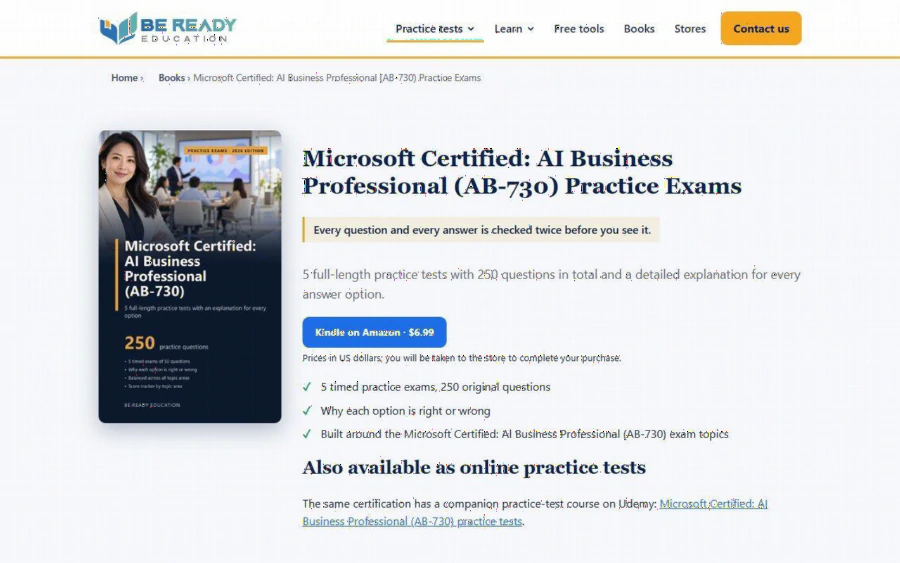
The Be Ready Education page for the AB-730 title, with the cover art, the 250 count, the Kindle price and the feature checklist
The same page points to an online course on Udemy for this certification, which suits people who would rather click through questions on a screen. The Udemy price is not shown on the Be Ready page, so check it on Udemy itself.
The page carries a line worth noting: every question and every answer is checked twice before you see it. That is the publisher's own statement, and I have no independent way to verify it. What you can verify is the structure, because the cover and the page both state five tests and 250 questions.
How the exam listing describes it
On the site's practice tests listing, the AB-730 entry shows five tests, 250 questions and 45 minutes. The listing page itself says each course has five full-length timed tests with every answer option explained. Nothing on that page gives a passing score, so confirm that, along with cost, languages and booking rules, on Microsoft's site before you commit to a date.
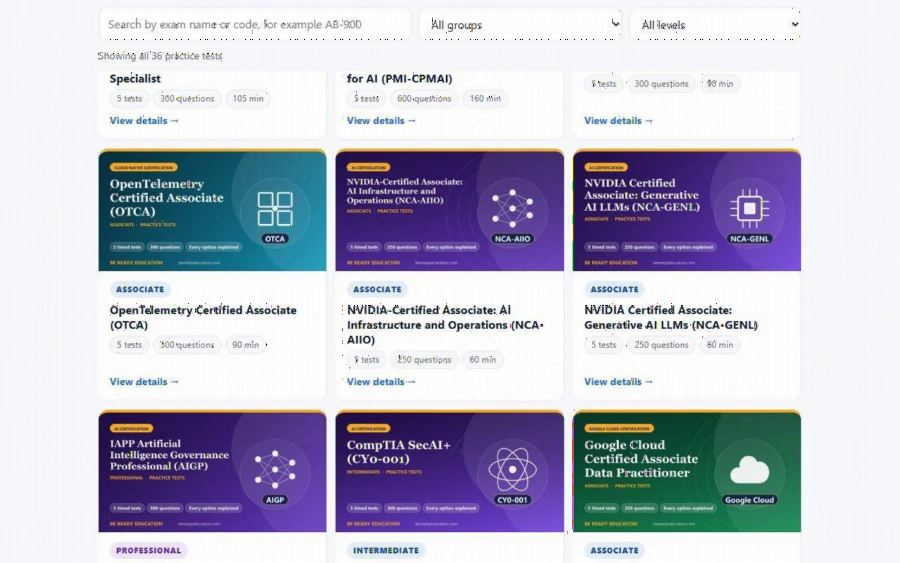
The Be Ready practice tests listing, showing cards for different certifications with the number of tests, questions and minutes on each
The full list of practice exams is also a quick way to compare certifications. It showed 36 practice tests when I looked, and every card carries the same three numbers, tests, questions and minutes. If a different AI or cloud certification fits your role better, you can see it there in a minute.
A study scenario for an ad operations lead
This is an illustration, not a real customer story. Imagine an operations lead at a small agency who manages billing, reporting and trafficking for a dozen accounts. She has three weeks and about an hour each evening.
Week one, she sits the first test with a stopwatch running and her notes closed. The score matters less than the pattern: which topics cost her points, and whether the clock is the problem. Fifty questions against a 45 minute listing is a tight pace for some people, though you should check the real timing on the page for the exam you book.
Week two, she goes through the explanations, even for answers she got right. Several options in a fundamentals question can sound reasonable, yet only one fits the situation described, so seeing why the rest fall short is the real lesson.
Week three, she logs weak topics in a simple list, goes back to Microsoft's own learning material for those, and only then takes the later tests. She books the exam when her scores are steady across several attempts, not after one good evening.
Where it helps and where it falls short
The main strength is the explanation attached to each option. Plenty of practice sets just mark a letter and move on, while a rationale for every choice lets you learn from a miss. Five tests also leave room to track a trend instead of trusting one score.
The limits are just as real. An ebook cannot adapt to what you answer, and timing yourself on some e-readers is clumsy, so you must police your own clock. The publisher states that its questions are written from scratch, so expect different wording from Microsoft's own. They also do not replace Microsoft's official material. I have no data on how readers score afterward, and a practice book cannot guarantee an outcome.
A good fit: media buyers, analysts, account managers and operations people who already use AI tools at work and prefer an organized check ahead of booking. A poor fit: people who have never opened an AI assistant and must start from zero, and anyone hoping to skip the studying. If the exam is not something you need, Microsoft's free learning pages and a few weeks of hands-on use will teach plenty without a certificate.
First steps
1. Open Microsoft's official AB-730 page and copy down the listed skills.
2. Pick Kindle or the Udemy course, then confirm today's price at the store.
3. Put one evening per test in your calendar and time yourself strictly.
4. Once a test ends, go through the explanations and list the topics you missed.
5. Schedule the real exam only after your scores settle.
Ad work rewards people who ask what a tool did and why. A few weeks of deliberate practice, with explanations that tell you where your reasoning slipped, is a modest and inexpensive way to sharpen that habit. Whether or not you take the exam in the end, you will know your own gaps better, and that is useful before the next campaign review lands on your desk.